The American Dream:
Starting in the 1700s, it was the idea that those in the U.S. could build a better life for themselves and their families through available freedom, hope and driven dedication.
It also didn't matter where in life or on the social scale one might be. The ladder of potential opportunities could be climbed even from the lower rungs.
Fast-forward to Oswego, Aurora, Plainfield and Naperville (IL) the late 2020s. The dream still floats, but it's become more opaque for high school and college students preparing to enter life's larger arenas. They now step into a version of the dream that includes:
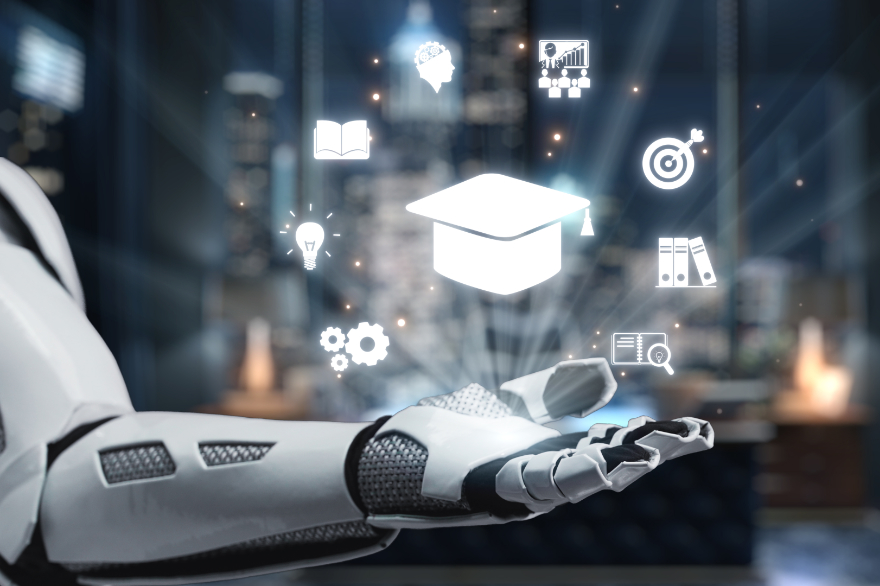
As they prepare to navigate those conditions, they also have to contend with a growing and powerful presence reaching into their endeavors: artificial intelligence.
Americans have long maintained the idea that a college degree was an accelerant for one's career path. For young people today, however, the launch into adulthood and independence feels less swift and automatic.
Compared with past decades, the perceived early-career advantage of a college degree appears to be less defined. In making hiring choices, more employers are seeking:
Potentially complicating matters, AI can now remove tasks once assigned to younger workers, such as clerical work, basic analysis, content drafts, junior coding work and some administrative functions.
This can create fewer roles among more applicants expected to meet entirely new qualifications, further reshaping the route to the American Dream once imagined as the domain of people alone.
For young people approaching life's great wide open, the current environment can prompt barrages of questions and thoughts that lead to stress and anxiety:
Will AI replace me?
AI can already do this better than I can.
What will the job market be like in 5 or 10 years?
Is my chosen major even worth it?
Will I ever be able to support myself?
These concerns further appear in a backdrop where:
about 11% of U.S. children (ages 3–17) have a current diagnosed anxiety disorder (Source)
among adolescents specifically, about 16% may have a diagnosed anxiety condition (Source)
roughly 1 in 3 teens may experience an anxiety disorder at some point (Source)
anxiety in youth increased ~60% in national surveys from 2016 to 2023 (Source)
We might agree that AI has come to represent a two-sided shadow of progress. At the same time, it presents opportunities for adaptation to human assets it cannot replicate.
In an AI-shaped future, we can't remove uncertainty, but we can increase how we use and perceive the technology. In this way, we can harness its power and speed to enhance our knowledge and skills with increasing precision while saving more time.
As AI moves deeper into education and the work force, students will need to focus on different skills from previous generations'. The days of memorizing facts and figures or plowing through dense research papers are now receding even faster.
Today's job-ready students can offer employers desired value in their capacity to:
What once used to be seen as soft skills are now hard advantages. While AI is strong at patterns, speed and repetition, it is weaker at original judgment, decision-making in context and measuring real-world ambiguity involving less prediction and structure.
Rather than fear AI as competition or a threat, students and young workers can leverage it to their advantage on their career path. AI allows students and young workers to:
speed up research, writing & coding
produce polished results quickly
evaluate generated output critically
combine AI with real-world knowledge
The transition period of a new technology can seem perilous and threatening, just as it did with the influence and growth of the internet in the 1990s.
As we continue using AI, we will remember that AI amplifies output but not always the depth of application and substance gained by human experience.
AI was built by – and is the result of – what it learned from humans. As with the web, the degree to which the genie leaves the bottle will be decided by how we manage and co-exist with the technology as it expands.
Research by the McKinsey Global Institute identifies the demand for AI fluency in job postings has increased nearly sevenfold over two years, making it the fastest-growing skill category they measure.
While students may face some competition from AI, many who know how to work with it are proving to be more employable. Recent research indicates that recruiters were much more likely to invite candidates for interviews if they demonstrated AI-related skills.
More employers are looking for more graduates who can use AI tools effectively, verify AI output and combine human judgment with automation. Rather than outright replacing careers, AI appears to be altering how value to professional careers can be established.
Modern history suggests that most careers evolve rather than disappear overnight. Large and new shifts in technology often create:
entirely new industries
new forms of creativity
new categories of work
higher productivity in certain professions
A frequently foreboding aspect of college preparation through the years has been the admission process.
One recent study showed that nearly one in eight students found admissions so stressful that they gave up on applying for college. One in four also attended therapy to support them with application-related anxiety.
Today's AI can help reduce some of this pressure and sense of being overwhelmed by handling certain repetitive, time-consuming and content-heavy tasks. This can let students focus on their applications' more personal, meaningful aspects, such as expressing distinctive strengths and showing their thought process in personal essays.
Today's young people already navigate an expanse of mental distractions and obstacles before they venture into life events such as applying for college and seeking a job. For some, the stress and anxiety can tip their emotional balance.
At Empowered Life Therapy, we help young people from Oswego, Aurora, Plainfield and Naperville reinforce their ability to manage difficult times with stability, calm and command.
In our experience, we've found that therapy combining practical coping tools, thinking-pattern frameworks and tolerance for uncertainty have often been effective in restoring and maintaining equilibrium.
Each individual will present differently under different circumstances. After learning about their situation and concerns, we might discuss skill-building approaches such as:
Healthy, productive therapy will reinforce a psychological outlook that:
focuses on adaptable skills rather than a perfect future-proof career
prioritizes strong social relationships
develops competence gradually instead of trying to master everything at once
limits doomscrolling and catastrophic AI content
views AI as a tool to learn and work with rather than as an all-powerful antagonist
In the end, the American Dream really is about believing a person's future does not have to be limited by their circumstances.
For young people today, that dream can remain very much alive as they adapt it to the age of AI in which they will learn, change and grow in their own distinctive ways.
Empowered Life Therapy believes in living as the authentic self with balance, peace and clarity. If you or someone you care about struggles with concerns about work or school, we are here for support. Simply contact us at (630) 383-9999 to connect with a professional serving Oswego, Aurora, Plainfield and Naperville (IL).
 Kasey Huff
